
Artificial intelligence opens up new possibilities for the development of complex products. It can analyze requirements, support design processes, accelerate simulations, generate test cases, or search technical knowledge bases. Generative AI and Agentic AI in particular promise to make knowledge-intensive tasks more efficient.
In many companies, however, these applications are still used only selectively. Individual AI solutions support specific tools, departments, or process steps, but often remain disconnected from one another. As a result, new isolated solutions emerge while data and knowledge continue to be distributed across different systems and engineering disciplines. The whitepaper »AI in New Product Development: Connecting Data & Unlocking Knowledge«, jointly published by Accenture, the German Research Center for Artificial Intelligence, and the Fraunhofer ISST, shows how AI can be scaled in product development beyond individual use cases.

From Individual AI Applications to Connected Development
Product development consists of numerous interconnected steps: requirements are defined, architectures are developed, components are designed, simulations are conducted, and systems are tested.
These processes generate large volumes of different data. In practice, this information is often stored in specialized tools, databases, and documents. Missing interfaces and inconsistent data formats make it difficult to use information across system and departmental boundaries.
A sustainable AI transformation therefore requires more than developing individual models or applications. Companies need a shared foundation that connects data, knowledge, processes, and engineering tools.
The Digital Thread as a Foundation for AI
The Digital Thread plays a central role in this context. It connects data and models throughout the entire product lifecycle, from initial requirements and design to production and product use.
This makes it possible, for example, to link requirements with components, simulation results, and test cases. Changes can be traced more easily, and their effects on other areas of development can be analyzed.
This context is particularly important for AI applications. An AI system does not only need access to individual data points. It must also understand how they are connected. The Digital Thread provides a continuous and traceable information basis for this purpose.
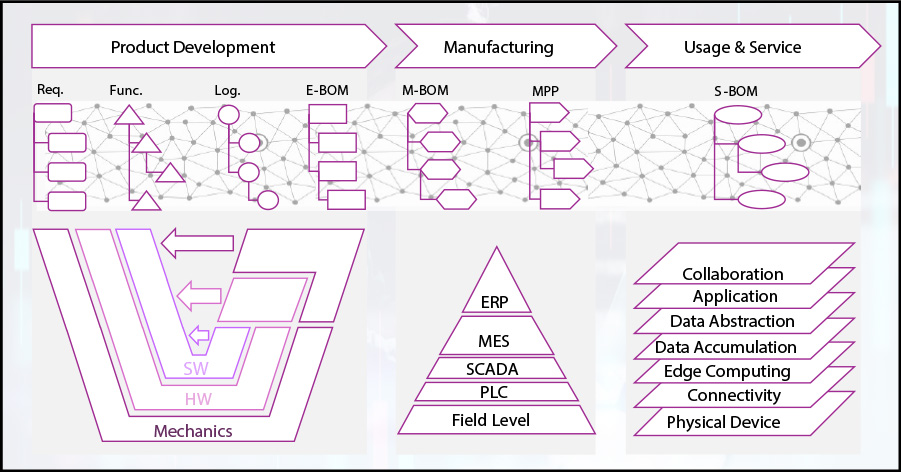
The Digital Thread connects product representations across development, manufacturing, and usage – from requirements and functions to mechanics, hardware, software, and bills of materials. Source: Molitor et al. (2025), AI in New Product Development, Fig. 1 © Accenture, Fraunhofer & DFKI.
Vertical and Horizontal AI Applications
The whitepaper distinguishes between vertical and horizontal AI applications.
Vertical applications support a clearly defined task within a specific tool or engineering domain. Examples include generating design alternatives, optimizing simulations, or automatically creating test cases.
Horizontal applications, by contrast, connect multiple engineering disciplines and data sources. One example is change management: If a requirement is modified, AI can analyze which components, models, simulations, and tests are affected.
Vertical use cases can create concrete value in the short term. However, the greater long-term potential arises when data and knowledge are connected across disciplines.
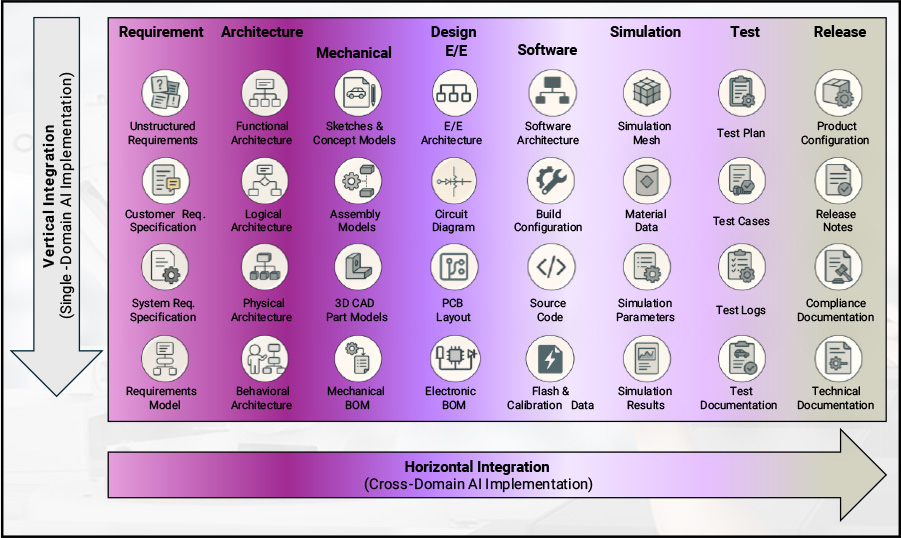
Vertical integration processes artifacts within a single engineering domain, while horizontal integration links and traces artifacts across domain boundaries. Source: Molitor et al. (2025), AI in New Product Development, Fig. 14 © Accenture, Fraunhofer & DFKI.
Five Requirements for Scalable AI
The whitepaper identifies five key dimensions that companies should consider when building a scalable AI landscape:
Data quality: AI applications require accessible, understandable, and sufficiently high-quality data. Relevant information should be structured and provided with appropriate metadata.
Interoperability: Engineering tools and AI applications must be able to communicate with one another. This requires technical interfaces as well as shared data models.
AI Platform: A shared platform provides computing resources, models, development environments, and tools for operating AI applications.
Context management: Knowledge graphs or vector databases can represent relationships between requirements, components, simulations, and tests, providing the necessary technical context.Federated governance: Shared rules must define how data and AI models are used, controlled, and monitored. At the same time, individual departments should retain responsibility for their respective data and processes.
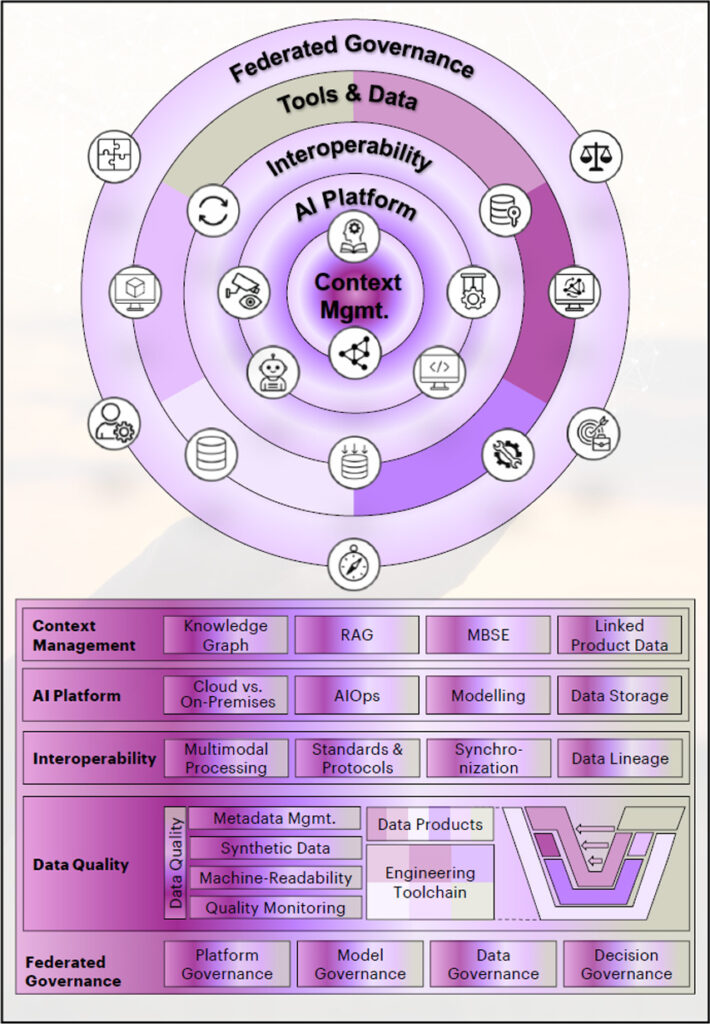
Five key dimensions of a scalable AI landscape in engineering: data quality, interoperability, AI platform, context management, and federated governance. Source: Molitor et al. (2025), AI in New Product Development, Fig. 3 © Accenture, Fraunhofer & DFKI.
Agentic AI in Product Development
AI agents represent a further stage of development. They can not only generate individual outputs but also plan more complex tasks, access tools, and coordinate several process steps.
An AI agent could, for example, analyze requirements, retrieve relevant design data, initiate a simulation, and propose changes based on the results. Several specialized agents could work together and perform different tasks.
For such scenarios to function reliably, agents need controlled access to data and engineering tools. Clear responsibilities and mechanisms for reviewing their results are equally important.
From Pilot Projects to AI Transformation
Companies do not have to choose between individual use cases and a comprehensive AI architecture. A gradual approach that combines both perspectives is more effective.
Concrete applications can generate value early on and provide practical experience. At the same time, they should be implemented in a way that allows them to be integrated into a shared data and platform architecture later.
This helps prevent successful short-term pilot projects from becoming permanently isolated solutions.
Conclusion
AI can support product development across numerous process steps. However, the greatest value does not come from individual models alone, but from connecting data, knowledge, engineering tools, and specialist departments.
The Digital Thread, interoperable systems, a shared AI Platform, and appropriate governance structures provide the necessary foundation. This enables companies to move gradually from individual AI applications toward connected and intelligent product development.
The whitepaper is based, among other sources, on an analysis of 137 scientific publications and combines academic findings with practical perspectives from industry.
Link
Whitepaper »AI in New Product Development: Connecting Data & Unlocking Knowledge«